
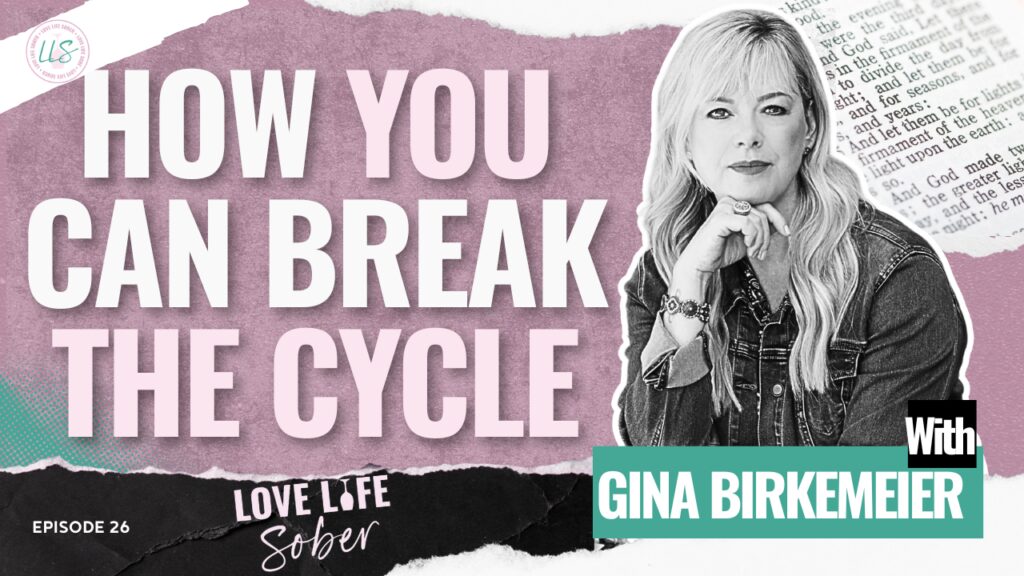
Generational trauma and addiction can feel like a story that was written before you ever had a chance to choose something different. Maybe alcohol misuse ran through your family. Maybe you grew up around dysfunction, neglect, emotional volatility, secrecy, shame, or abuse. Maybe you have looked at your own relationship with alcohol and wondered, Was this always going to happen to me?
The good news is this: your family history matters, but it does not have to determine your future.
In this powerful episode of the Love Life Sober Podcast, Christy Osborne sits down with licensed professional counselor, trauma expert, author, and speaker Gina Birkemeier, LPC, to talk about generational trauma, addiction, epigenetics, family patterns, shame, alcohol, the nervous system, and the healing power of faith.
Gina’s story is one of inherited dysfunction, early trauma, alcohol use, and repeated family patterns — but it is also a story of redemption, repair, courage, and deep transformation. Her work helps people understand the patterns they inherited, the stories they have believed, and the freedom that is possible when they begin healing with God, therapy, community, and truth.
If you have ever wondered why addiction seems to run in families, whether your drinking is connected to childhood trauma, or whether it is really possible to break the cycle for the generations after you, this conversation is for you.
Watch The Episode Here:
Listen to the Episode
Meet Gina Birkemeier, LPC
Gina Birkemeier, LPC, is a licensed professional counselor, international speaker, trauma expert, and author of Generations Deep: Unmasking Inherited Dysfunction and Trauma to Rewrite Our Stories Through Faith and Therapy.
Her work explores the intersection of faith, psychology, biology, epigenetics, trauma, and family healing. Gina specializes in helping people understand inherited dysfunction and rewrite the stories that have shaped their lives.
But this work is not theoretical for Gina. It is personal.
Gina grew up surrounded by neglect, abandonment, abuse, addiction, emotional instability, and family dysfunction. As she shares in this episode, her own story included early alcohol use, drug use, sexual abuse, emotional parentification, and a nervous system that was constantly scanning for danger.
Alcohol became one of the ways she coped. It took the edge off. It helped her feel like she could breathe. It quieted the noise inside.
But over time, God began showing her that what had been passed down through her family did not have to continue through her.
Why Addiction Can Run in Families
When people say addiction runs in families, they are often noticing something real.
Gina explains that family history can create what she calls a pre-existing genetic vulnerability. In other words, someone may have a biological predisposition toward addiction. But that does not mean addiction is inevitable.
This is where epigenetics becomes so important.
Epigenetics looks at how our environment, relationships, stress, support, sleep, nutrition, trauma, and mental health can influence which genes are expressed and which are not.
That means family history matters, but so do the conditions of your life now.
The patterns you inherited are not powerless. The choices you make today matter. The support you receive matters. The healing you pursue matters. Your relationship with God matters. Your community matters. Your nervous system matters. Your sleep matters. Your mental health matters.
You may have inherited a vulnerability, but you can cultivate a life that helps interrupt the expression of that vulnerability.
This is one of the most hopeful parts of the conversation.
You are not doomed by your DNA.
Generational Trauma Is Not Just About Alcohol
One of the reasons generational trauma and addiction can be so complex is that the pattern does not always show up in the same form.
In one generation, it may look like alcohol misuse.
In another, it may look like emotional avoidance.
In another, it may look like anxiety, perfectionism, people-pleasing, workaholism, food issues, gambling, prescription drug misuse, or toxic relationships.
The surface behaviour may change, but the underlying pattern can remain the same.
This is why Christian sobriety is about so much more than simply removing alcohol. Alcohol is often not the root issue. It is the solution we have been using to manage pain, fear, stress, grief, loneliness, boredom, shame, or overwhelm.
When we stop drinking, God often begins revealing what alcohol was covering.
That can feel uncomfortable. But it is also where healing begins.
Alcohol, Trauma, and the Nervous System
Gina describes growing up in a home where she was constantly scanning the emotional state of the adults around her. This is common for children raised in chaotic, unpredictable, or emotionally unsafe environments.
The nervous system learns to stay alert.
It learns to monitor.
It learns to anticipate danger.
It learns to over-function, people-please, comply, or disappear.
So when alcohol enters the story, it can feel like relief.
For many women, alcohol is not about rebellion or indulgence. It is about trying to feel safe, calm, confident, connected, or numb.
That is why shame is so unhelpful.
If we only ask, “Why can’t I stop drinking?” we may miss the deeper question: “What has alcohol been doing for me?”
Has it been helping me calm down?
Has it been helping me sleep?
Has it been helping me avoid grief?
Has it been helping me tolerate loneliness?
Has it been smoothing over tension in my marriage?
Has it been helping me fit in socially?
Has it been helping me numb emotions I never learned how to process?
Those questions are not excuses. They are information. And information helps us heal.
Why Shame Keeps Women Stuck
One of the most powerful parts of this episode is Gina’s encouragement to women who feel ashamed of their drinking, especially mothers who worry about what their children have seen.
Gina is clear: shame is one of the enemy’s most effective tools.
Shame feeds addiction.
Shame feeds the false narrative that says, “I am too far gone. I have messed up too much. My children have seen too much. My story is too broken.”
But shame does not heal us. God does.
Gina encourages women to take shame into the light: first to God, and then to safe, trusted people. We were created for relationship. Healing does not happen in isolation.
This matters deeply for Christian sobriety.
Many women do not need more condemnation. They need truth, support, honesty, repair, and community.
Repairing Ruptures With Our Children
For mothers who are carrying regret about alcohol, Gina offers a deeply compassionate and practical path forward.
Do not hide.
Do not pretend.
Do not minimize.
When appropriate and safe, open the door for honest conversation.
That may sound like:
“I know there were times when my drinking affected you. I am so sorry. I am doing the work now, and if there are things you want to talk about, I want to listen.”
The key is to listen without defending, justifying, minimizing, or rationalizing.
This is repair.
And repair is powerful.
Your children do not need a perfect mother. They need to see what it looks like when a woman tells the truth, takes responsibility, clings to Jesus, does the hard work, and changes.
That is a beautiful legacy.
What If Your Children Are Already Adults?
Gina also speaks tenderly to empty nesters and women whose adult children witnessed the full impact of family dysfunction or alcohol.
The invitation is still repair, honesty, humility, and support.
But Gina also names something important: you cannot do your adult child’s healing for them.
You can take responsibility for your part.
You can make amends where appropriate.
You can create a healthier relationship now.
You can become a safe person.
But you cannot carry their boulder for them.
Just as you have to decide to become a cycle breaker, your children also have to decide what healing looks like in their own lives.
That does not mean you stop loving them. It means you trust God with them.
And that can be one of the hardest and holiest parts of healing.
Curses Don’t End. They Are Broken.
One of Gina’s most memorable lines in this episode is this:
“Curses don’t end. They’re broken.”
That is the invitation.
We do not simply wait for generational patterns to fade away. We participate with God in breaking them.
We tell the truth.
We get help.
We stop hiding.
We learn how to feel.
We stop using alcohol to numb what needs to be healed.
We become honest about what happened to us and honest about what we have done with our pain.
We allow God to rewrite the narrative.
And slowly, imperfectly, faithfully, the cycle begins to break.
What If My Story Is Too Broken?
Many women hear conversations like this and think, That sounds lovely for someone else, but my story is too hard. Too much has happened. I have done too much damage. I am too far gone.
Gina’s response is direct and full of truth: that voice is condemnation, and it is not from God.
If you have breath in your lungs, there is something you can do today.
Healing will not be linear. It will not be neat. It will not be perfect. But no one heals in a straight line.
The first step may be telling the truth.
The next step may be joining a community.
The next step may be finding a trauma-informed therapist.
The next step may be doing a 40-day alcohol fast.
The next step may be opening your Bible and asking God, “What do You say is true about me?”
You do not need to see the whole path.
You only need to take the next faithful step.
What To Do Instead of Numbing
If you are sitting with a hard emotion today, Gina offers a gentle and practical invitation:
Name it.
Externalize it.
Take it to God.
Bring it into community.
Journal about it.
Ask what is true.
Ask what you need.
Ask what God might want to put in its place.
There is a difference between processing pain and reinforcing pain. Rumination keeps us trapped. Honest processing helps us move through.
If alcohol has been your way of escaping hard feelings, sobriety may feel raw at first. But over time, you will begin to see that emotions are not emergencies. They are information.
They do not have to be numbed.
They can be brought into the healing presence of God.
Why Christian Sobriety Breaks More Than a Drinking Pattern
Christian sobriety is not just about behaviour change.
It is about legacy change.
It is about the woman who says, “This may have been passed to me, but by the grace of God, it does not have to keep passing through me.”
It is about the mother who stops hiding.
It is about the daughter who tells the truth.
It is about the grandmother who gets help.
It is about the woman who realizes alcohol has been smoothing over pain that God wants to heal.
It is about breaking agreement with shame.
It is about learning a new way to live.
It is about becoming the kind of woman who can say, “I am worth not drinking.”
And it is about trusting that God is not finished with your story.
Frequently Asked Questions
Can generational trauma cause addiction?
Generational trauma can increase vulnerability to addiction, especially when patterns of neglect, abuse, emotional instability, secrecy, or substance use are passed down through families. However, vulnerability is not destiny. Healing, support, therapy, faith, community, and lifestyle changes can all help interrupt inherited patterns.
Why does addiction run in families?
Addiction can run in families through a combination of genetic vulnerability, learned coping patterns, trauma, environment, stress, and family culture. A child may inherit both biological risk and behavioural patterns, especially if alcohol or substances were used to cope with pain, stress, or emotional dysregulation.
What is epigenetics?
Epigenetics is the study of how environment and life experiences can influence gene expression. In the context of addiction, it helps explain why a person may have a genetic vulnerability but not necessarily develop an addiction. Factors like support, sleep, nutrition, mental health, relationships, stress, and trauma can influence whether certain vulnerabilities are expressed.
Can Christians break generational cycles?
Yes. Christians can break generational cycles through the healing power of God, honest confession, repentance, therapy, community, renewed thinking, changed behaviour, and intentional repair. Breaking cycles is not usually instant or linear, but with God’s help, families can begin to write a new story.
Is alcohol always the problem?
Not always. Alcohol is often the symptom or the coping mechanism. Many women use alcohol to manage anxiety, stress, loneliness, grief, shame, trauma, boredom, or emotional overwhelm. Removing alcohol creates space to heal what alcohol was covering.
How do I stop feeling ashamed of my drinking?
Shame loses power when it is brought into the light. Take it to God, share with a safe person, seek support, and pay attention to the narrative you are feeding yourself. Shame says, “You are too far gone.” God says, “You are redeemable.”
What should I do if my kids saw me drinking?
Start with honesty and repair. When appropriate, acknowledge what happened, apologize without defending yourself, and let your children know they can talk to you. Then continue doing the work. Your children get to witness not perfection, but humility, courage, healing, and dependence on Jesus.
What if I have adult children and regret how alcohol affected them?
You can take responsibility, make repairs where possible, and become a healthier person now. But you cannot do your adult child’s healing for them. You can love them, listen to them, apologize sincerely, and trust God with the work only He can do.
What can I do instead of numbing hard emotions?
Name the emotion, pray, journal, talk to a trusted friend, reach out to your community, or seek professional support. The goal is not to let emotions drive the car or to lock them away, but to notice them, listen to them, and process them with God.
Reflection Questions
Where have I seen alcohol used as a coping tool in my family story?
What patterns did I inherit that I no longer want to carry forward?
What emotion have I been most tempted to numb?
What shame narrative have I been believing?
What would repair look like in one relationship?
What is one small step I can take today to interrupt the cycle?
Who do I need to invite into this healing journey?
About Gina Birkemeier’s Book
Gina is the author of Generations Deep: Unmasking Inherited Dysfunction and Trauma to Rewrite Our Stories Through Faith and Therapy. The book combines Gina’s personal story, professional counseling expertise, faith, science, epigenetics, therapy, reflective questions, and practical tools for healing inherited dysfunction.
It is designed not just to be read, but to be used as a resource for people who want to understand their story and begin healing generational patterns.
Join Gina’s Masterclass Inside the Love Life Sober Community
Gina will also be joining the Love Life Sober Community for a special August masterclass on the generational impact of alcohol and the patterns we inherit.
We will explore how alcohol invites us to hide rather than heal, the connection between shame and the nervous system, and what it looks like to break generational patterns through faith, honesty, and support.
If you are already inside the community, keep an eye out for details.
If you are not yet inside, this is a beautiful time to join us.
🎙️ Listen More
- Will my marriage survive if I quit drinking?
- How Do I Stop Using Alcohol To Cope?
- Healing Doesn’t Happen Alone with Toni Collier
📖 Read More
- Christian Sobriety, When Willpower Isn’t Enough
- I Kept Reaching For The Wine, When What I Needed Was Jesus
- Which Thought Will You Choose?
🤍 Ready for Support?


