
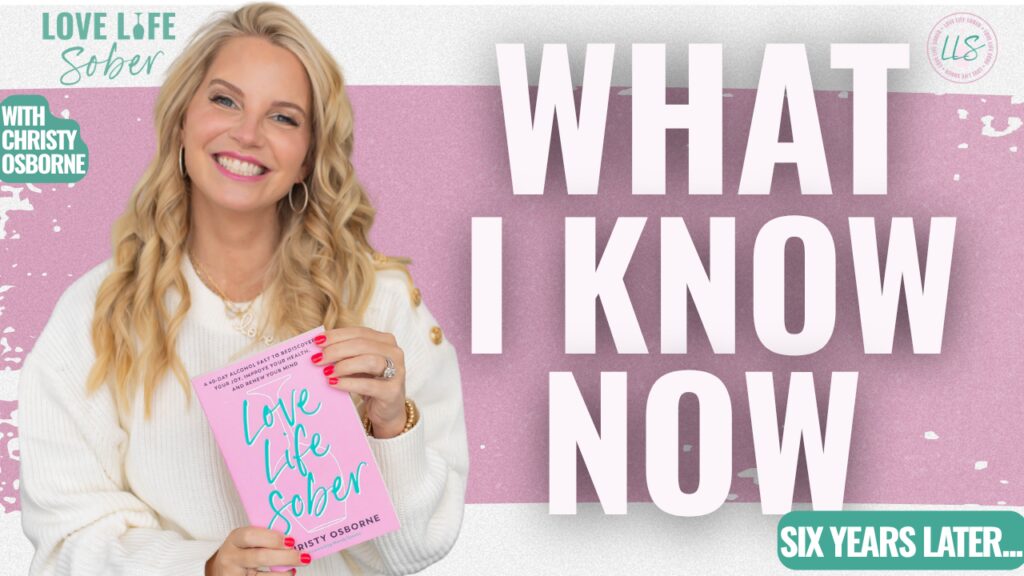
It’s one of the questions I get asked all the time, and in this week’s episode of the Love Life Sober Podcast, I’m the one in the hot seat. Instead of asking the questions, I’m answering them—completely off the cuff—about what six years of freedom from alcohol has actually taught me.
And yes, sobriety has gotten easier. So much easier.
There was a time when I could picture the glass of Sauvignon Blanc. I could imagine the condensation on the glass and exactly how that first sip would feel. When I was grieving, stressed, overwhelmed, or desperate to change how I felt, alcohol was the tool my brain immediately offered me.
That isn’t where I am anymore.
When Does Sobriety Get Easier?
I don’t think there was one magical day when I woke up and suddenly didn’t want alcohol anymore. It happened gradually.
Over time, I stopped having to work so hard to remind myself where that glass of wine would actually take me. I stopped romanticizing the first twenty minutes and started automatically remembering the rest of the story: thinking about another drink, rushing through bedtime so I could keep drinking, sleeping terribly, and waking up wishing I hadn’t done it.
Eventually, not drinking became my normal.
In fact, one of the things we talk about in this episode is the point when drinking would actually feel stranger than not drinking. I love that description because I think it gives so much hope to the woman who currently feels like every dinner, holiday, vacation, girls’ night, or Friday evening requires a decision about alcohol.
It doesn’t always feel this hard.
Six Years Sober Doesn’t Mean Life Is Always Easy
This past year was a really hard one for me.
And something I realized in the middle of it was that although I didn’t want to drink, I could still desperately want to check out.
I could still want to escape a feeling. I could still want my brain to quiet down. I could still wish I could press some giant emotional eject button and feel differently for a while.
That distinction matters.
Because for so many of us, alcohol wasn’t really the thing we wanted in the first place. We wanted what we believed alcohol could do for us.
We wanted relief.
We wanted relaxation.
We wanted our brains to stop spinning.
We wanted grief to hurt less, anxiety to quiet down, stress to disappear, or the transition from one part of our day to another to feel easier.
And when you stop drinking, you get the opportunity to learn how to meet those needs differently.
Learning to Cope Without Alcohol
One of the biggest things I’ve learned in six years without alcohol is that healthy coping mechanisms take practice.
Today, when I’m overwhelmed, I might walk out the door and start walking. I might put on a worship song and get on the walking pad in my office. I might take a hot shower, breathe, pray, journal, or simply try to get back into my body and get with God.
Those things sound simple.
But when you’ve trained your brain for years—or decades—to respond to I’m stressed with I need a drink, choosing something different doesn’t necessarily feel natural at first.
Your brain has learned a script.
The beautiful news is that you can teach it a new one.
As Christian women, we get to think about this through the lens of renewing our minds and taking our thoughts captive. We don’t simply grit our teeth and try harder not to drink. We can begin changing the thoughts, beliefs, habits, and patterns underneath our drinking.
And that takes us to one of the most important lessons I’ve learned:
This Was Never Just About Alcohol
Physically not drinking can eventually become the easy part.
The deeper work is discovering why you were reaching for alcohol in the first place.
What job did you give it?
Was it your reward? Your stress relief? Your permission to stop working? Your way of connecting with your husband? Your answer to loneliness? Your way of coping with grief? The thing that made social situations feel easier?
This is why I don’t believe shame helps us change.
Curiosity does.
Instead of What is wrong with me?, we can begin asking:
Why did I want that drink?
What was I hoping it would give me?
Did it actually give me that?
How did I feel an hour later?
How did I feel the next morning?
What else might give me what I’m actually looking for?
Those questions can be powerful even if you’re not ready to quit drinking forever.
What If You’re Not Ready to Stop Drinking Forever?
You don’t have to figure out forever today.
If you’re taking a break from alcohol—or simply starting to wonder whether drinking is still serving you—get curious.
Pay attention to how alcohol actually makes you feel rather than how you’ve been conditioned to believe it should make you feel.
Notice how much mental space it takes up.
Notice the negotiation: Should I have another? I said I’d only have one. Maybe I’ll have one more. When can I drink again?
And start building other tools now.
Prayer. Walking. Journaling. Exercise. Calling someone. A hot shower. Worship music. Going outside. Rest.
Alcohol doesn’t have to remain the only tool in your toolkit while you’re figuring out what comes next.
Why Community Matters in Sobriety
We also talk in this episode about something I believe is integral to lasting freedom: community.
We cannot heal alone.
There is enormous relief in walking into a space where you don’t have to present the shiniest version of yourself. You can say the thing you’ve been afraid to say out loud and discover that the women around you aren’t horrified.
They’re saying, Me too.
For Christian women especially, alcohol can become the thing we’re willing to talk about almost anywhere except church. We can sit in Bible studies and small groups while keeping this one part of our lives carefully hidden.
Shame thrives in that isolation.
Connection begins when we allow ourselves to be known.
And if you haven’t found your people yet, please keep looking. There are women who understand. There are communities where you don’t have to explain or defend why you’re questioning your relationship with alcohol.
Does Sobriety Get Easier? Yes.
Six years later, I can tell you that not drinking is no longer the hard part.
Life can still be hard.
Grief is still grief. Stress is still stress. Fear still feels like fear. There are still moments when I would quite like to hit an emotional eject button.
But I don’t need alcohol to do it anymore.
And perhaps that’s one of the greatest freedoms I’ve found in all of this.
Freedom isn’t never experiencing a hard emotion again.
It’s knowing that you can experience it without needing to escape from it.
Watch Here:
Listen Here:
In this episode, you’ll learn:
- When sobriety started to feel easier for me
- Why wanting to “check out” can still happen years after you stop drinking
- What to do if you’re taking a break from alcohol but aren’t ready to think about forever
- Why curiosity works better than shame when examining your drinking
- How your brain learns to use alcohol as an automatic coping mechanism—and how you can retrain it
- Why developing a toolkit for stress, anxiety, grief, and big emotions matters
- What to look for if you’re considering a sobriety coach
- Why community can be such an important part of healing
If you’ve ever thought…
Why is this still hard when I know so much? When does sobriety get easier? Will not drinking ever feel normal? What if I’m not ready to quit alcohol forever? Why do I keep reaching for wine even when I know it isn’t helping me?
This episode is for you.
🍂 You Don’t Have to Feel Ready. You Just Have to Start Somewhere.
The next Love Life Sober 40-Day Alcohol Fast begins October 5th.
Maybe you’ve been thinking about your drinking more than you want to admit. Maybe you keep telling yourself you’ll cut back, take a break, or figure it out later. And maybe the thought of actually doing something about it feels really scary.
The October Fast is 40 days to step away from alcohol and find out if life is better without it. We’ll walk through my bestselling book, Love Life Sober, together, with four live coaching calls every week, an incredible team of coaches, and a private community of women who understand exactly what this feels like.
No labels. No forever promises. Just 40 days to see what might be possible.
We begin October 5th.
👉 LEARN MORE ABOUT THE OCTOBER FAST
Continue Your Journey
If this conversation resonated with you, you may also enjoy:


