
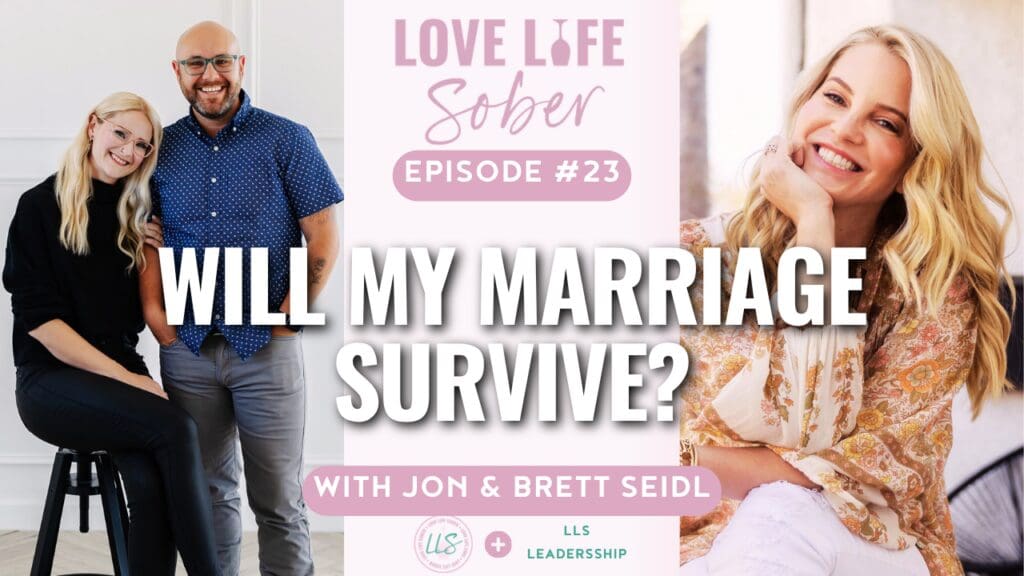
Can your marriage survive if you get sober and your spouse keeps drinking? Here’s what I’ve learned from my own journey and from coaching hundreds of women through theirs.
One of the most common concerns I hear from women who are sober curious is this:
“What happens if I stop drinking but my husband doesn’t?”
For many women, the fear of how sobriety might affect their marriage keeps them stuck for months or even years. They worry about date nights, vacations, social events, intimacy, and whether they’ll still feel connected to their spouse if alcohol is no longer part of their life.
If that’s you, I want you to know something important:
Your marriage does not require alcohol to thrive.
In fact, many women discover that removing alcohol creates opportunities for deeper connection, healthier communication, and a stronger relationship than they ever thought possible.
Can a Marriage Survive When One Spouse Gets Sober?
The short answer is yes.
When I stopped drinking in March 2020, my husband didn’t stop drinking.
Many people assume that if one spouse chooses an alcohol-free life, the other must follow suit for the relationship to work. But that’s not necessarily true.
My husband still drinks occasionally. He didn’t suddenly become interested in sobriety podcasts, alcohol research, or quit-lit books. What changed was me.
One of the most freeing realizations of my early sobriety journey was understanding that my relationship with alcohol was my responsibility. Not my husband’s. Not my friends’. Not anyone else’s.
When we stop trying to manage other people’s drinking, we can finally focus on our own healing.
Why Women Fear Sobriety Will Hurt Their Marriage
Alcohol often becomes intertwined with how couples spend time together.
It shows up on date nights, holidays, vacations, celebrations, and stressful evenings after work.
Because of this, many women begin to believe that alcohol is helping create connection in their marriage.
But in reality, alcohol is often carrying responsibilities that were never meant to belong to it.
We tell ourselves alcohol helps us relax, communicate, connect, and have fun. Yet those are all things that healthy relationships can create without a drink in hand.
The fear isn’t usually about losing alcohol.
It’s about losing connection.
Marriage After Sobriety: What Actually Changes?
One of the biggest surprises many women experience is realizing that alcohol wasn’t creating intimacy. It was often masking the absence of it.
True intimacy requires presence.
It requires vulnerability, honesty, listening, and emotional availability.
Alcohol can sometimes create the feeling of connection while allowing couples to avoid difficult conversations.
When alcohol is removed, those conversations may finally happen.
That can feel uncomfortable at first.
Resentments that have been buried become visible. Communication patterns become clearer. Unspoken expectations rise to the surface.
But visibility is not the same thing as damage.
More often than not, it’s the beginning of healing.
When Your Husband Still Drinks
If your husband continues to drink, it can be tempting to focus on his choices rather than your own.
You may find yourself wanting him to understand everything you’ve learned about alcohol.
You may wish he would change alongside you.
You may even wonder whether he should stop drinking too.
But lasting transformation rarely comes through persuasion.
It comes through example.
People notice when you’re calmer.
They notice when you’re sleeping better.
They notice when you’re more patient, more present, and more joyful.
The most powerful thing you can do is live the change.
A Christian Perspective on Sobriety and Marriage
One of the deepest fears women have is this:
“What if I grow and he doesn’t?”
The truth is that none of us can control another person’s journey.
We can’t force transformation.
We can’t make someone choose growth.
What we can do is remain faithful to the work God is doing in us.
Romans 12:2 reminds us:
“Do not conform any longer to the pattern of this world, but be transformed by the renewing of your mind.”
Notice that Paul doesn’t tell us to transform our spouse.
He tells us to focus on our own transformation.
God is fully capable of handling the rest.
The Unexpected Gift of an Alcohol-Free Marriage
One of the things I’ve witnessed repeatedly, both personally and through coaching, is that many couples discover something unexpected after alcohol is removed.
A deeper friendship.
Better communication.
More trust.
More intentionality.
More genuine connection.
Not because alcohol was taken away.
Because presence was added.
Sobriety doesn’t automatically fix a marriage. But it does create an opportunity to show up fully awake to your life and your relationship.
And that can change everything.
Listen to the Full Podcast Episode
This topic inspired a powerful conversation on the Love Life Sober Podcast.
This week, I was joined by bestselling author Jon Seidl, his wife Brett, and members of the Love Life Sober leadership team to discuss marriage, sobriety, intimacy, communication, faith, and what happens when one spouse changes their relationship with alcohol and the other doesn’t.
Together we share real stories, practical encouragement, and hope for women navigating sobriety while their husband still drinks.
Listen Here:
Watch Here:
Maybe you’re listening to this episode and realizing you’re carrying questions you’ve never said out loud.
Questions like, “Why does this still feel so hard?” or “Am I the only Christian woman struggling with this?”
Babe, you’re not alone.
That’s exactly why we created the Love Life Sober Community and why we’re gathering women from all over the world for the Aligned Conference 2026.
Inside our community, you’ll find weekly connection calls, monthly masterclasses, prayer, encouragement, and women who truly get it. No pretending. No perfect people. Just honest conversations and lots of grace.
And if you’re craving real-life hugs, worship, connection, and the chance to spend a few days surrounded by women pursuing freedom together, we’d love to see you at Aligned in Holland, Michigan this September.
You don’t have to figure this out on your own anymore.
Come join us. 🩷


